
Quick answer: A source-only supply can support a validated charging or device-power test. Discharge and repeated cycling require an electronic load, a documented bidirectional supply or a battery cycler. Voltage range alone does not establish battery-test suitability.
On this page
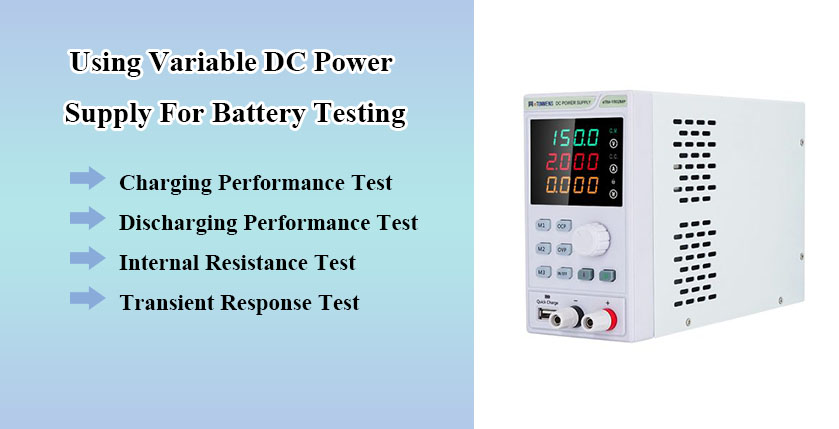
Match the equipment to the test
| Test | Equipment role | Important limitation |
|---|---|---|
| Controlled charging | Source with an appropriate validated charge procedure | Chemistry-specific limits and termination remain essential. |
| Discharge capacity | Electronic load or documented current-sinking instrument | An ordinary source-only supply cannot absorb battery energy. |
| Repeated cycling | Coordinated source/load or battery cycler | Needs safe transitions, monitoring and fault handling. |
| Resistance/transient assessment | Controlled current change plus suitable voltage measurement | A basic supply alone is not an internal-resistance meter. |
Source power is not sink power
A supply’s output voltage and current ratings describe its sourcing capability unless the documentation states otherwise. Before connecting a battery, check external-voltage and reverse-current limits. Do not assume that output OFF isolates a battery or that the supply provides a regenerative discharge function.
Define the test protocol
- Use the battery manufacturer’s charging, discharge, termination and temperature requirements.
- Select connections and fault protection appropriate for the battery and fixture.
- Record voltage/current measurements, temperature and timestamps with the instrument configuration.
- Define what happens on loss of communications, overtemperature or an interrupted sequence.
Measurement quality
Resolution is not accuracy. Compare source setting accuracy, readback accuracy and the independent measurement method under the intended range and temperature conditions. Where lead drop matters, measure at the intended battery or fixture terminals and follow the instrument’s connection rules.
Choosing a 60V 30A power supply for battery testing
A 60V, 30A supply is a candidate for the sourcing side of a battery test when the required voltage, current, continuous power and connection protections fit the complete setup. A “60V battery” label alone is not enough: use the battery manufacturer’s maximum charging voltage. A nominally 60V pack may need more than a 60V supply can provide.
| Your test requirement | Equipment and model selection |
|---|---|
| Programmed voltage/current settings for a validated sourcing or charging procedure | eTM-6030C is a 0–60V, 0–30A programmable candidate with selectable communication options. Match the settings, charge termination and protection arrangement to the battery. |
| Manual voltage/current adjustment with output control and readings | eTM-6030 provides four-knob coarse/fine adjustment; its listed communication function is On/Off/Read. |
| Controlled discharge or capacity measurement | Use a suitably rated electronic load, a documented current-sinking instrument or a battery cycler. |
| Repeated charge/discharge cycles | Use coordinated source/load equipment or a cycler with defined transitions, measurements and fault handling. |
Power and input configuration
A test point of 54V and 20A requires 1080W; 60V and 30A requires 1800W. These figures describe the load requirement. Select a supply configuration that supports the voltage and current together for the required duration. The eTM-6030C 110–130V AC option is limited to output power of 1200W or less, so it does not cover the 60V, 30A test point.
Charging, BMS checks and battery simulation
A BMS-related fixture may need a pack-level source, independently controlled cell voltages, a discharge path, or several of these functions. A single-output bench supply provides one output; cell-level monitoring and balancing tests need the appropriate cell-simulation or multi-channel equipment. Choose the equipment for the actual BMS test rather than the pack voltage alone.
Battery simulation also involves more than setting a voltage. A charger test can require an instrument that absorbs current, while other tests may need programmed battery behaviour. Match the source and sink functions to the device under test. For a defined charging test, use the battery manufacturer’s current limits, termination conditions and temperature monitoring, with model-specific backfeed and connection protection.
For a suitable sourcing task, open eTM-6030C to choose its product options and order online. Compare the 60V DC power supply range for other current requirements, or read the 60V 30A model comparison for manual versus programmable control.
Need help with a communication option or test configuration? Email us or contact us on WhatsApp.
Choosing ETOMMENS equipment
An ETOMMENS bench or programmable supply can be evaluated for a suitable sourcing task within its documented capabilities. Confirm the exact model’s interface, protections and battery-connection requirements. Use separate sink equipment or a dedicated cycler when the test requires discharge.
Practical checks
| Check | What to verify |
|---|---|
| Charge protocol | Use chemistry-specific limits, termination and temperature monitoring. |
| Discharge | Select equipment with a documented current-sinking function. |
| Reverse energy | Confirm backfeed and external-voltage limits before connecting a battery. |
| Data | Record voltage, current, temperature, timestamps and instrument settings. |
Updated