
Quick answer: Specialized supplies can power X-ray subsystems or bias radiation detectors. General laboratory supplies are not automatically approved for clinical or patient-connected operation; suitability depends on the validated medical-system design.
On this page
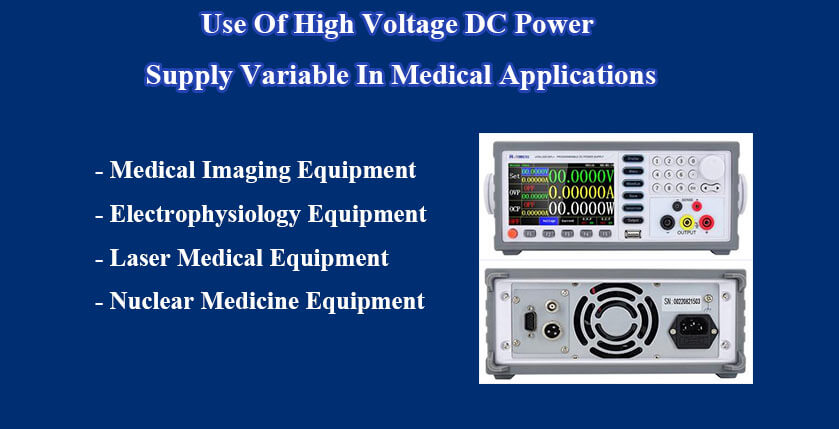
Medical subsystem requirements differ
An X-ray generator, detector-bias supply and patient-connected monitoring circuit do not have interchangeable power requirements. Specialized high-voltage sources can be used in appropriately designed imaging or detector systems; a general bench source is not an automatic replacement.
Power quality and patient safety are different checks
Output ripple, regulation and dynamic behaviour affect subsystem performance. Isolation, leakage-current control, protective measures and relevant approvals affect medical-system safety. A stable output specification does not establish clinical suitability.
Detector bias is not isotope stabilization
High voltage can bias a photomultiplier or other suitable detector. It does not supply power to a radioactive isotope or stabilize that isotope. The equipment designer must specify detector voltage, polarity, noise and protection requirements.
Research and clinical use
A laboratory supply may support engineering development within its documented limits. Patient-connected or clinical equipment requires the appropriately approved complete system and a validated design. Do not infer medical approval from a supplier’s general application list.
Specify the exact subsystem
- Load function, required voltage/current/power and operating waveform.
- Insulation, isolation and leakage requirements of the complete system.
- Noise, stability, protection and stored-energy requirements.
- Applicable approvals and the evidence needed from the subsystem supplier.
Practical checks
| Check | What to verify |
|---|---|
| Subsystem | Specify whether the load is an X-ray source, detector or research fixture. |
| Isolation | Use documented system-level insulation and leakage requirements. |
| Performance | Check ripple, stability, response and stored energy. |
| Approval | Confirm the required certifications for the complete equipment. |
Updated