
Updated
Quick answer: Both models list adjustable 300V and 5A ranges. The useful comparison is mains compatibility, controls, documented protections and configuration—not an unsupported claim that one is universally best.
On this page
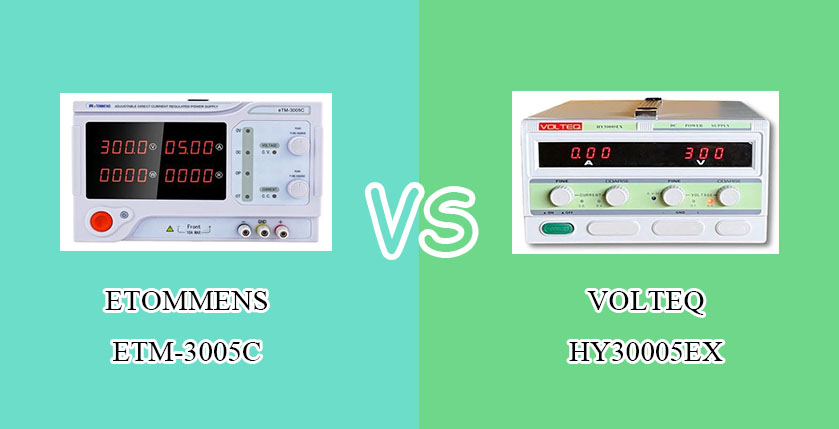
Documented model comparison
| Item | ETOMMENS eTM-3005C | VOLTEQ HY30005EX |
|---|---|---|
| Output range | 0–300V, 0–5A | 0–300V, 0–5A |
| Output power | 300V × 5A = 1500W; confirm continuous conditions | 1500W listed by VOLTEQ |
| Input | ETOMMENS listing specifies AC220V; confirm the ordered variant | VOLTEQ listing specifies 110–120V AC and a circuit rated 20A or more |
| Controls | Encoder adjustment and output ON/OFF listed | Coarse/fine voltage and current adjustments listed |
| Protections/options | Model page lists multiple protections; SENSE and communication are optional | Model page lists overvoltage and overcurrent protection |
Compare noise and accuracy fairly
A display format does not establish output accuracy. A sensitive experiment depends on the exact setting/readback, regulation and ripple specifications under its test conditions. Noise figures measured with different bandwidths or load conditions are not a direct ranking.
Which model fits the installation?
Mains compatibility can determine the decision before finer features. Confirm input requirements, grounding, branch-circuit capacity and ventilation with the model’s manual and installation plan. High voltage requires a controlled fixture and appropriately rated connections; internal protection does not make accessible terminals safe.
Check your actual load
Specify operating voltage, current, continuous duty and whether the load is capacitive, inductive, arc-producing or able to return energy. Neither a 300V headline nor a protection list establishes suitability for every process. Request configuration-specific confirmation for special loads.
Maintenance and acceptance
- Inspect external connections with output disabled and follow the discharge instructions.
- Keep ventilation clear and investigate abnormal heat or shutdown.
- Use a documented calibration and acceptance procedure for measurement-critical work.
- Use qualified service for internal inspection or repair.
Practical checks
| Check | What to verify |
|---|---|
| Operating point | Confirm voltage, current and continuous power together. |
| Mains input | Match the ordered input configuration to the installation. |
| Interfaces | Confirm optional communication and SENSE for the purchase decision. |
| Measurements | Compare regulation and noise using matching test conditions. |