
Updated
Quick answer: Select voltage, current and continuous power at the real operating point, then verify output insulation, connectors, stored energy, protections and measurement requirements. A high voltage rating does not make a general supply suitable for every high-voltage process.
On this page
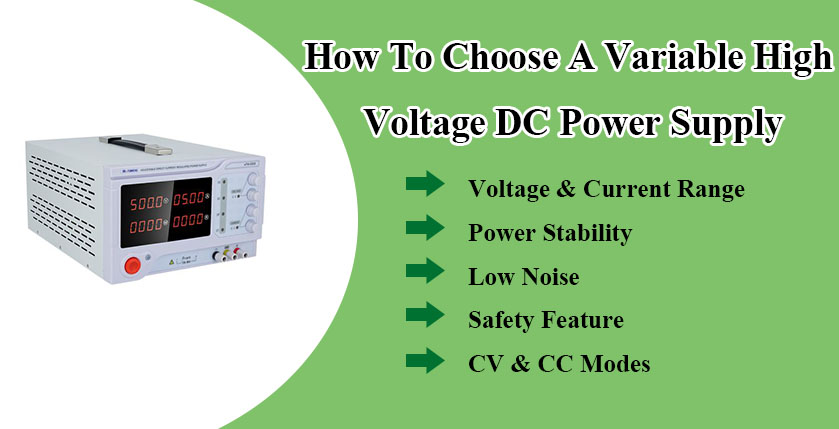
Write an operating-point table
List the minimum and maximum test voltage, the current needed at each voltage, and how long each condition lasts. For example, 500V at 2A requires 1000W, while 800V at 1A requires 800W. The selected model must meet each point within its documented continuous operating envelope.
Characterize the load
Identify whether the DUT is mainly resistive, capacitive, inductive or able to return energy. Arc-producing processes and dielectric-withstand tests may require specialized equipment. A general high-voltage DC source is not automatically a hipot tester or a regenerative instrument.
Define output quality
- Permitted setting and measurement error at the intended range.
- Line/load regulation under specified operating conditions.
- Ripple/noise with a stated measurement bandwidth.
- Voltage and current response to the real load waveform.
Specify the complete installation
Output insulation, connectors, cabling, enclosure, discharge procedures and controls belong in the system design. Ask whether the instrument provides an inhibit/interlock function when the fixture requires one. Protection functions can support the design but do not replace the required operator safeguards.
Request evidence before ordering
Obtain the exact model manual, input-power requirements, interface options and configuration-specific quotation. For a remote-sense setup, confirm the allowed compensation range and fault behaviour. Agree how the supply will be accepted for the intended load.
Practical checks
| Check | What to verify |
|---|---|
| Operating envelope | List minimum/maximum voltage, load current and required power. |
| Load behaviour | Identify capacitive, inductive, arc-producing or energy-returning loads. |
| Controls | Specify inhibit/interlock and remote-control requirements if needed. |
| Verification | Request the model manual and a configuration-specific quotation. |