
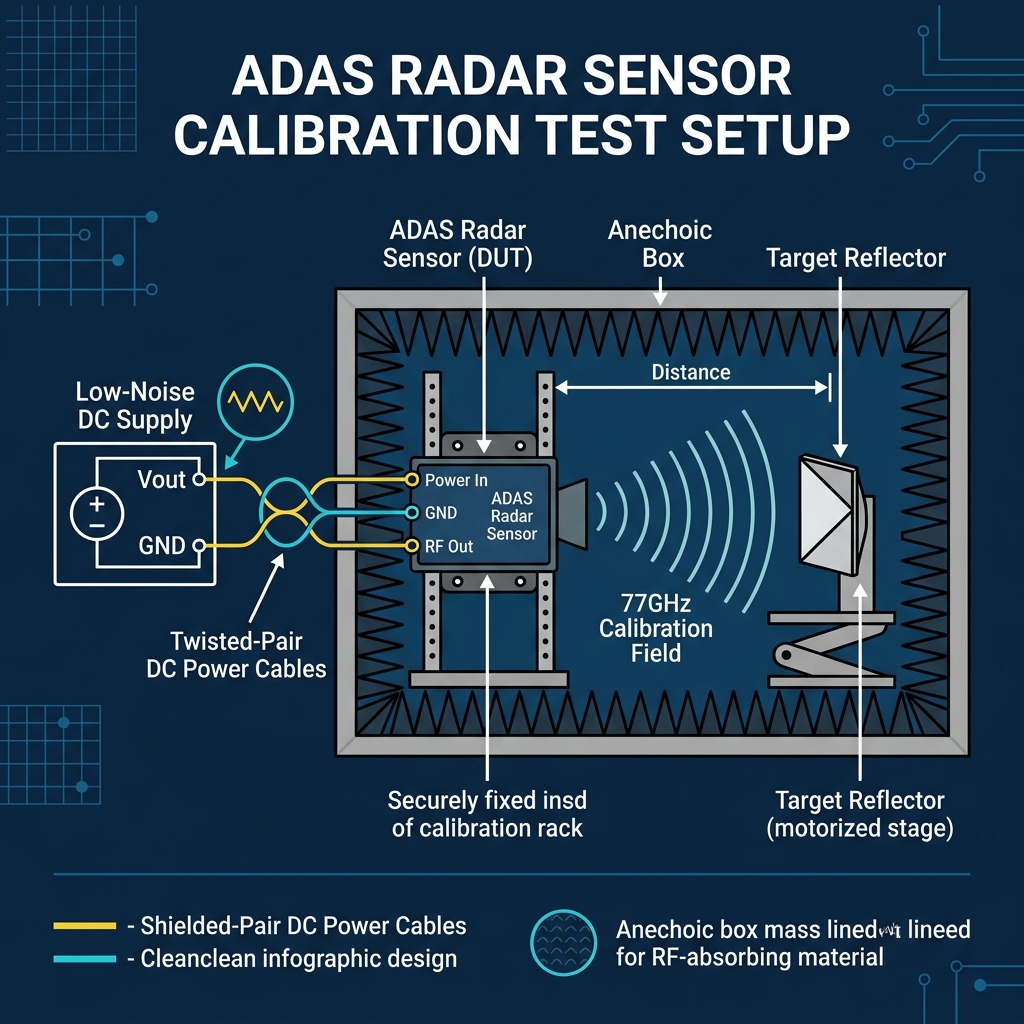
A DC power supply for automotive testing provides a controlled source for ECU, sensor, actuator and vehicle-module bench tests. The right model depends on the DUT voltage, steady and startup current, protection requirements and whether the test needs manual adjustment or repeatable programmable control.
On this page
Which automotive devices are being tested?
Automotive bench testing covers several different loads. A 12V ECU or sensor board usually needs a stable low-voltage source with visible voltage and current. A 24V commercial-vehicle module may need a higher adjustment range. A blower motor, fuel-pump controller or radiator-fan assembly can demand much more current during startup and operation.
| Automotive test load | Typical supply consideration |
|---|---|
| ECU or sensor board | Adjustable 12V-class output, current limiting and output ON/OFF. |
| 24V vehicle module | Voltage range that covers the nominal rail and test margin. |
| Actuator or controller | Startup and operating current, protection and cable capacity. |
| Fan, pump or motor-related load | Higher current headroom and continuous power capability. |
Voltage and current ranges
For standard 12V automotive electronics, a 0–30V supply covers the nominal rail and common bench-test adjustments. A 24V vehicle module may also fit within a 0–30V range when the required margin is included. Specialized 48V systems may require a 0–60V or higher model.
Current capacity should cover the normal load and the startup event. A sensor or controller may need only a few amps, while a fan or pump controller can require 20A, 30A or more. The model’s continuous power envelope matters as much as its maximum current number.
Output voltage and current should be visible before the output is enabled. This makes it easier to set the intended limits before connecting the DUT.
Features that matter on an automotive bench
Output ON/OFF control allows the operator to set and review the voltage and current limits before energizing the module. Overvoltage protection, overcurrent protection and short-circuit behavior help contain common wiring and fixture faults. The exact thresholds and response are model-specific.
For repeated ECU or sensor tests, programmable setpoints, stored presets and a documented remote interface reduce manual variation. A USB connector or digital display alone does not establish PC control; the model documentation identifies the supported interface and commands.
Remote SENSE is useful when current and cable length create a meaningful voltage difference at the DUT. It regulates the load-side voltage on models that support the required four-wire connection. It does not replace correct cable ratings or an automotive transient test system.
Model examples for automotive testing
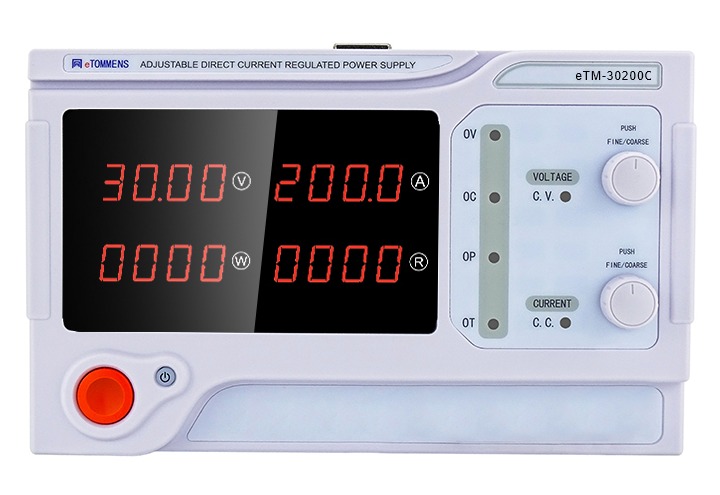
The eTM-30200C is intended for low-voltage, high-current automotive module and actuator testing. The correct selection follows the DUT voltage, continuous current, startup current and test duration.
When a specialized automotive test system is needed
A general adjustable DC supply is suitable for many ECU, sensor, controller and module bench tests. A specialized automotive test system is a separate requirement when the test must reproduce defined battery transients, cranking events, load-dump conditions, network behavior or an automotive standard waveform.
High-voltage EV inverter and powertrain testing also belongs to a separate equipment class. An 800V DC supply can provide the required voltage source for a laboratory setup, but the complete system still requires the appropriate isolation, discharge, interlock and guarded measurement arrangement.
Choosing the right product category
Use the Programmable DC Power Supply category for repeatable ECU, sensor and module tests. Use the 800V DC Power Supply range for high-voltage EV or inverter laboratory work. Fixtures with independent positive, negative or auxiliary rails belong in the Multiple Output DC Power Supply category.
Automotive test supply specifications
| Specification | What to compare |
|---|---|
| Voltage | 12V, 24V, 48V or high-voltage DUT range and test margin. |
| Current | Startup, continuous and peak demand. |
| Output control | Output ON/OFF, presets and programmable setpoints. |
| Protection | OVP, OCP and short-circuit response. |
| Interface | Documented USB, RS-232, RS-485 or Ethernet functions. |
| Test class | General bench supply versus dedicated automotive waveform system. |
Updated