Aluminum process development
Evaluate coupons, machined components and rack arrangements before scaling up. Set current for the exposed area and follow the voltage required as the oxide layer develops.

Anodizing & Surface Finishing
Controlled current for aluminum process trials. Adjustable voltage for titanium finishing. DC power matched to the parts, the bath and the production run.
Compare bench supplies for sample development, small-batch work and pilot fixtures, then choose your configuration online.
Compare Power Supplies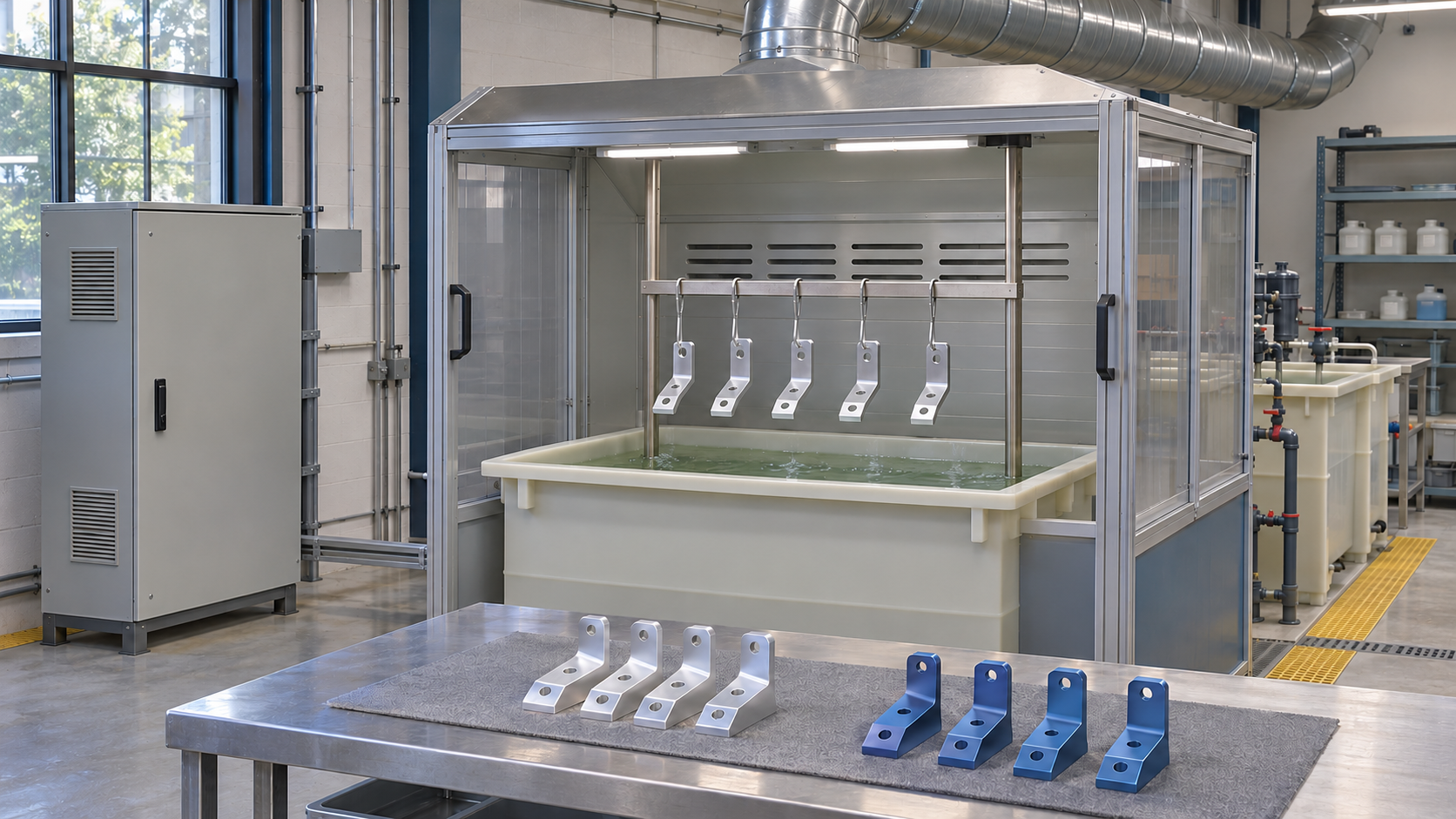
Illustrative anodizing process environment.
Evaluate coupons, machined components and rack arrangements before scaling up. Set current for the exposed area and follow the voltage required as the oxide layer develops.
Run several parts on one rack with a supply sized for the total load. Current capacity, secure contacts and consistent cycle settings become increasingly important as batch size grows.
Explore voltage-controlled oxide finishes on titanium parts. Select the voltage range for the intended finish and retain the same surface preparation and bath conditions between trials.
The power supply controls electrical output. The tank, racking, bath temperature, agitation and finishing stages complete the process.
The workpiece forms the anode. A secure rack connection carries current to the exposed part surfaces.
The cathode completes the circuit through the electrolyte. Cathode material and arrangement follow the process specification.
Locate bench equipment in a dry, ventilated position away from bath mist and splashes. Provide suitable leads, protected connections and process interlocks as part of the installation.
Total exposed area, parts per rack and the current density specified for the process determine the required amperage. Include all surfaces receiving treatment in the batch calculation.
Current (A) = area (dm²) × current density (A/dm²).
Bath voltage, increasing coating resistance, cable losses and rack contacts determine the source voltage needed to maintain current. Aluminum, hard-anodizing and titanium processes can require different ranges.
Current-controlled aluminum runs need enough voltage compliance to maintain the set current. Titanium color trials place particular emphasis on the applied voltage. Select the control mode around the process recipe.
Maximum simultaneous voltage/current, run duration, cooling and AC input capacity. Check the complete cycle rather than only the initial setpoint; output power availability depends on the selected input configuration.
Output ripple and regulation, terminal capacity, lead length and contact resistance. Low-ripple output supports controlled DC processing, while reliable rack contacts and bath control remain essential to consistent finishing.
Manual setpoints or programmed changes, interface selection and batch logging. Choose the required RS232, RS485 or USB option for remote control; pulse and polarity-reversing processes require equipment with those specific capabilities.
If your process specifies 1.5A/dm², a 40dm² load needs 60A. At a 20V operating point, the electrical output is 1,200W.
A 30V / 100A model is a candidate if the entire cycle stays within its voltage and power capability. This is a sizing example, not an anodizing recipe.
At the same specified current density, the required current becomes 120A. A 100A supply no longer covers the load; compare the 200A model and its available power at the required voltage.
If the process needs more than 30V, select a wider-voltage model with sufficient current rather than increasing current capacity alone.
Start with the required voltage and batch current. Each model below links to its specifications, available options and online purchase page.
Aluminum batches and fixtures whose complete voltage requirement fits within 30V.
Compare Recommended ModelsProcess trials needing more voltage headroom at moderate current.
Compare Recommended ModelsHigher-voltage finishing trials, including titanium processes within the model’s range.
View Recommended ModelSmall-batch and pilot loads requiring up to 100A. Adjustable 0–30V output and CV/CC control make this a candidate for current-controlled runs within the available output envelope. Preset voltage/current and switch the output independently during fixture setup.
View Product & OptionsMore current capacity at the same voltage range. Compare this model when increasing part area raises demand above 100A. Its 0–30V / 0–200A controls support higher-current fixtures, with input configuration, connections and available output power matched to the run.
View Product & OptionsSamples and smaller loads needing a wider voltage range. Adjustable output up to 60V and current control up to 30A provide a candidate for process development within this range. Review the available input and communication options on the product page.
View Product & OptionsMore current capacity for 60V-class fixtures. Adjustable 0–60V / 0–50A output, CV/CC operation and optional remote interfaces support manual trials and PC-controlled setpoints. Compare the complete voltage/current cycle with the selected configuration.
View Product & OptionsVoltage-controlled trials extending beyond 60V. Adjustable 0–120V output provides a wider working range for a specified titanium finishing process. Current control, output switching and optional interfaces support repeatable electrical settings.
View Product & OptionsFor titanium, applied voltage influences the oxide film and resulting color. Surface preparation, material and bath conditions also affect the result.
Choose the range required by your process rather than treating maximum voltage as a guarantee of a particular finish.
Low ripple and noise, CV/CC operation, voltage/current presets, four-digit LED display, encoder adjustment and a separate output on/off control.
Temperature-controlled cooling and overvoltage, overcurrent, overpower, overtemperature and short-circuit protection. Communication, SENSE compensation and external trigger options depend on the selected configuration.
Select the AC input and available options on each product page. Input selection can limit available output power. These bench supplies provide DC output; pulse-reverse operation and complete tank-line controls are separate equipment requirements.
A bench supply suits sample work and small fixtures; a process rack needs space for airflow, cable routing and access to the controls. Match the AC input option to the installation and size output leads and workpiece connections for sustained batch current.
Front-panel voltage and current controls suit process trials. For repeated setpoint changes, select an available communication interface compatible with the line controller. Confirm command support for the intended sequence and use separate process instrumentation where required.
Long leads and rack connections introduce voltage drop between the supply and bath. Keep connections appropriately rated and secure; where supported, a remote-sensing option can compensate within the model’s specified limits. Locate the supply away from splashes and corrosive vapour.
Multiply the total exposed surface area by the current density in your process specification. For example, 40dm² at 1.5A/dm² needs 60A. Then check that the supply can maintain that current throughout the required voltage range.
Current-controlled aluminum anodizing uses a set current related to exposed area, with sufficient voltage available as the coating develops. Titanium color anodizing often uses an applied-voltage target. Follow the specified process for the material and finish.
Only when the complete cycle, including connection losses, stays within its voltage capability. Compare a 60V or wider-range model if the process needs more voltage, while retaining sufficient current capacity for the batch.
A bench source can provide regulated DC for development and appropriately sized fixtures. A production line may also require specialized enclosures, tank controls, interlocks, cooling and a different output waveform. Select the complete installation around the line requirements.
The recommended models are presented here as adjustable DC sources. A communication interface alone does not provide pulse-reverse capability. Use equipment specifically rated for the waveform and polarity sequence your process requires.
Selected configurations offer RS232, RS485 or USB control. Match the interface and command support to your process software and the required setpoint sequence; add suitable logging when batch records are needed.
Yes. Use the product links above to review the model, select its available configuration and order online. The product page shows the price for the selected options.
ETOMMENS serves small and medium-sized businesses, large enterprises and multinational groups, including customers in North America, Europe and the Middle East. Adjustable output and configurable control interfaces support a range of laboratory and pilot-system requirements.
Explore the full variable DC power supply range or open one of the anodizing candidates above to configure your order.
You can buy ETOMMENS DC power supplies for anodizing online at VariableDCPowerSupply.com. In-stock models dispatch within 1–3 business days after payment, with approximately 10 business days in transit. Free worldwide DDP shipping includes customs clearance, import duties and taxes.
Lead times for custom configurations are confirmed with the quotation.