
BATTERY PACK AGING & TESTING
DC power for battery pack testing
Set the voltage and current for charge, hold and bias steps. Match the source to the pack voltage, charging current and test sequence.
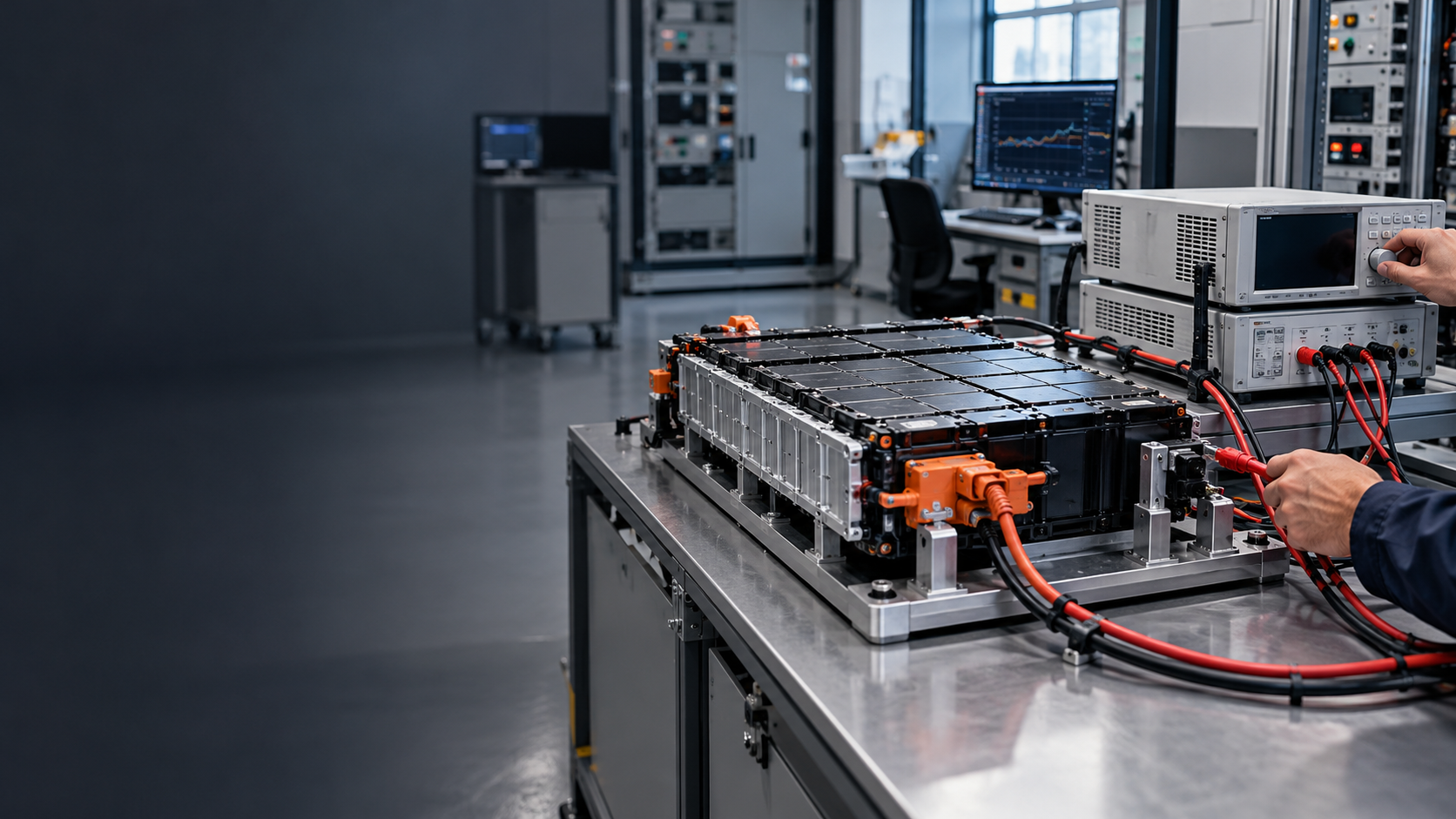
Power source within the test system
A battery aging bench needs a controlled source, a defined load or discharge path, and measurement that can be repeated. Select the supply from the pack voltage, current, power and test sequence—not from the voltage label alone.
Where the supply connects
The supply is one part of the measurement path. Confirm the battery pack, load, controller, wiring and protection as a complete test setup.
Typical test setups
Pack aging
Repeated charge, hold and measurement cycles for development and validation fixtures.
Module validation
Defined source conditions for module-level comparison and end-of-line checks.
Production verification
A repeatable supply and measurement path for production-line testing.
Energy-storage R&D
Flexible voltage and current ranges for engineering benches and prototypes.
Battery test power supply requirements
Maximum pack charging voltage
The charging voltage depends on cell chemistry and the number of cells in series. The power supply must cover the pack’s specified end-of-charge voltage and the voltage settings used in the test sequence.
Charging current
Charge current and pack voltage determine the required source power. For example, a 60V, 20A operating point requires 1,200W of output. Current limiting and voltage control must work with the battery’s charging profile and BMS.
Continuous operation
Long charge and hold stages place sustained demands on the source. Continuous output ratings, ambient temperature, ventilation and rack airflow matter throughout the test—not just at startup.
Channel count
Independent channels let separate packs run at different voltage and current settings. Multi-pack fixtures also need adequate total system power, individual channel protection and suitable channel isolation for their wiring arrangement.
Control and data logging
Automated stations coordinate setpoints, output switching, measurements and test timing through a controller or PC. The selected interface and command set determine what can be controlled and read back; logging software and temperature measurement complete the test record.
Reverse-current protection
A connected battery can feed energy back toward the power supply when its output is disabled or falls below the battery voltage. The fixture needs a reverse-current protection arrangement suited to the source and pack. Discharge stages require an electronic load or a battery cycler with the necessary energy-absorption capability.
Compare power supplies for battery testing
Match the pack’s maximum charging voltage, charging current and channel count to the source. For battery connections, include the reverse-current protection and charging controls described above.
60V Bench Power Supplies
For battery pack test setups requiring adjustable DC output up to 60V.
High-Voltage Bench Power Supplies
For higher-voltage fixtures where current and power must be checked at the intended operating point.
Modular Multi-Channel Power Supplies
For several independent battery channels or rack-integrated test fixtures.
60V Bench Power Supplies
eTM-6030C — 60V, 30A
For single-pack test fixtures with source requirements within the 0–60V, 0–30A range. View the available input, connection and interface options on the product page.
eTM-6050C — 60V, 50A, 3000W
Higher-current, lower-voltage test fixtures. Adjustable 0–60V output and 0–50A current control provide a source for charging stages within this operating range. CV/CC operation and optional RS232, RS485 or USB support manual and PC-controlled stations.
High-Voltage Bench Power Supplies
eTM-5005C — 500V, 5A
Higher-voltage pack development. The 0–500V range suits source stages requiring more voltage and moderate charging current. Preset voltage and current before enabling the output; add a programmable interface for automated setpoints.
eTM-8006C — 800V, 6A
Extended-voltage laboratory fixtures. Adjustable 0–800V output extends the source range for higher-voltage test systems. CV/CC control, an independent output switch and optional remote interfaces support controlled source steps.
Modular Multi-Channel Power Supplies
eTM-UMM-6 — modular multi-channel
Several independently controlled test channels. A modular rack configuration accommodates different source requirements across a multi-pack fixture. Select the module combination and total power for the planned channels.
The C-series models above include low-ripple, low-noise output, temperature-controlled cooling and overvoltage, overcurrent, overpower, overtemperature and short-circuit protection. AC input configuration can limit available output power; product options show the applicable limits.
Open a C-series product to select its available options and order online. Modular rack configurations are specified separately on the product page.
What to Consider When Choosing a DC Power Supply for Battery Pack Testing
A bench supply suits a single test fixture. When packs need different setpoints or separate start and stop control, an independently controlled multi-channel system can support several fixtures in one rack. Match the module combination and total system power to the channels that will run together.
Front-panel controls suit development work and fixed-output hold tests. Repeated charge and hold steps call for a compatible control interface and command support. Select the required RS232, RS485 or USB option where available, and pair the supply with the test controller and measurement equipment used to record results.
For a station that already has a BMS, data acquisition and electronic load, choose a source that fits its control and wiring arrangement. A conventional DC supply provides the charging source; discharge requires suitable load equipment. Include reverse-current protection, rated leads and output switching in the battery connection design, and select the AC input and available interface options for the installation.
Battery pack testing FAQ
How do I choose the voltage and current range?
Use the highest required operating point for the pack, then check the model’s complete voltage-current-power envelope.
Does an aging test need programmable control?
It depends on the sequence. Manual control may suit simple hold tests; automated cycling usually requires the confirmed interface and command support of the selected model.
Can one system test several modules?
A multi-channel rack system may suit independent channels. Confirm channel count, module mix and total system power for the intended fixture.
Can a standard DC supply discharge a battery?
Do not assume it can. Confirm whether the selected system supports the required load, discharge or bidirectional function.
ETOMMENS products and technical support
ETOMMENS serves small and medium-sized businesses, large enterprises and multinational groups across North America—including the United States and Canada—Europe, and the Middle East.
Choose the output range and control options your test station needs. Online product configuration, technical support and customized solutions support both individual development benches and larger test installations.
Power supplies for your battery test station
Compare 60V bench supplies, higher-voltage sources and modular channels for your pack’s charging and measurement requirements.
Compare Power SuppliesExplore all variable DC power supplies
Where to Buy DC Power Supplies for Battery Pack Testing
You can buy ETOMMENS DC power supplies for battery pack testing online at VariableDCPowerSupply.com. In-stock models dispatch within 1–3 business days after payment, with approximately 10 business days in transit. Free worldwide DDP shipping includes customs clearance, import duties and taxes.
Lead times for custom configurations are confirmed with the quotation.