
Reviewed October 28, 2026
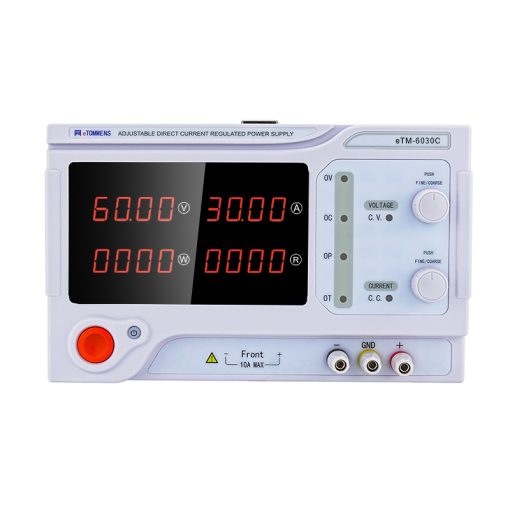
Which 60V 30A DC power supply is best for your bench? Within the ETOMMENS range, choose eTM-6030C for a two-knob supply with programmable communication options. Choose eTM-6030 for four-knob coarse/fine adjustment where manual settings and its listed On/Off/Read communication meet the test.
The best choice depends on how you will use the output: one manually adjusted operating point, a programmed sequence of input voltages, or a test involving a battery or another energy-returning load. Both models list 0–60V and 0–30A adjustment ranges, but their control functions differ.
On this page
60V 30A bench power supply comparison: eTM-6030C vs eTM-6030
| Selection point | eTM-6030C | eTM-6030 |
|---|---|---|
| Voltage / current ranges | 0–60V / 0–30A | 0–60V / 0–30A |
| Front-panel adjustment | Two-knob encoder controls | Four knobs for coarse/fine adjustment |
| Communication function listed | Programmable | On/Off/Read |
| Interface information | RS232, RS485 or USB options on the product page | Optional interfaces described; confirm the required fitted configuration |
| Output and measurement | Output switch and four-digit LED display | Output switch and four-digit LED display |
| SENSE | Optional rear SENSE configuration | Optional rear SENSE configuration |
| Choose a model | View eTM-6030C and options | View eTM-6030 and options |
Choose for the way you test
Repeated input-voltage settings in a PC-controlled fixture
Choose eTM-6030C when the test program needs to set voltage and current limits, rather than only read values or enable the output. Its selectable RS485, RS232 and USB options let you match the instrument configuration to the controller. Use the supplied command documentation to implement the required sequence and readback.
For example, a test plan might power a DC-input device at 24V and 48V and record current at each point. The fixture still needs to support the device’s startup behaviour and any returned energy. A programmable supply provides the source settings; the complete fixture determines the test method.
Hands-on development and manual adjustment
Choose eTM-6030 when separate coarse and fine knobs suit frequent front-panel changes. It offers a 60V, 30A adjustment range, an output switch and voltage/current display. Its listed remote function is On/Off/Read, which suits a different role from software-controlled voltage/current setting.
A load requiring 48V and 20A
This working point needs 960W. Both 30A models cover the stated voltage/current ranges; compare the actual continuous-output and AC-input configuration, then choose the controls you need. A 20A model is also a candidate if startup and continuous demand stay within its permitted limits. Browse the 60V DC power supply models for other current ranges.
Does 60V 30A mean 1800W?
A load drawing 30A at 60V requires 60 × 30 = 1800W. A supply used for that test must support those values together for the required duration. Maximum voltage, maximum current and a broad wattage-category tag do not by themselves establish a configuration’s continuous output rating.
The eTM-6030C product page offers a 110–130V AC input option limited to output power of 1200W or less. That option cannot power a 60V, 30A load. For full-range operation, choose a configuration with the necessary continuous-output and AC-input capacity.
For a load at 48V and 30A, the required output power is 1440W. Reducing voltage can reduce the power requirement, but it does not make a 1200W configuration sufficient for every working point below 60V.
Controls, lead drop and protection
Both models list CV/CC operation. In constant-voltage operation the supply regulates voltage; when the load demand reaches the current setting, constant-current regulation can reduce the output voltage. This matters during startup: an overly restrictive current limit may keep a device from reaching its normal operating state.
At high current, lead resistance can create a noticeable difference between the supply terminals and the load. If the test needs remote voltage sensing, select the available SENSE configuration and use its wiring and compensation limits. SENSE can compensate voltage drop within its specified range; adequate output leads and connections remain necessary.
Both product pages list overvoltage, overcurrent, overpower, overtemperature and short-circuit protection. Configure the test’s limits for the connected equipment. A four-digit display describes the display format; setting accuracy, readback accuracy and ripple/noise are separate selection criteria.
Can I use a 60V 30A supply for battery testing?
A 60V-range supply can be a candidate for a defined charging or sourcing task when the battery manufacturer’s voltage, current and termination requirements fit the setup. The maximum required voltage matters more than the battery’s nominal label. A pack sold as “60V” may require more than 60V during charging.
Discharge-capacity and charge/discharge cycling tests need controlled current sinking as well as sourcing. Select the complete source/load or cycling setup and the required reverse-energy protection. Read the battery-testing equipment guide for the distinction between charging, discharging and cycling.
60V 30A power supply questions
Which model is best for RS485 automated testing?
Of these two ETOMMENS models, eTM-6030C is the candidate for programmable voltage/current control. Select its RS485 option and use the model-specific command documentation. eTM-6030 lists On/Off/Read instead.
Can a 60V 30A supply power a device that only draws 5A?
The current rating is the available capacity, not a command to force 30A into every device. In CV operation, the load draws current according to its behaviour, up to the configured limit. Choose voltage and current limits appropriate to the device.
Can I run a 60V 30A load from the listed 110V option?
Not with the eTM-6030C 110–130V configuration limited to 1200W. The load needs 1800W at the output. Select an AC-input and output configuration that covers that working point.
Is a 60V supply suitable for every 60V battery pack?
No. Compare the pack manufacturer’s maximum charging voltage, required current, termination method and connection protections. A nominal 60V label is not the maximum charging voltage, and charging capability is different from discharge capability.
Choose your 60V 30A model
Select eTM-6030C for programmable control or view the four-knob eTM-6030, choose the available configuration and order online.
Need help with a communication option or test configuration? Email us or contact us on WhatsApp.
Compare the full 60V model range if your current requirement differs.
Related: RS485 programmable DC power supplies. For other voltage ranges, browse our variable DC power supplies.